The Crisis
Most of us sense it. Something is wrong — not just with the climate, not just with the economy, not just with the political landscape, but with all of it simultaneously, in ways that feel connected even when we struggle to articulate exactly how. That feeling is not anxiety. It is not pessimism. It is accurate perception. The world is facing a convergence of crises unlike anything in recorded human history — accelerating climate breakdown, collapsing biodiversity, extreme wealth concentration, rising authoritarianism, democratic erosion, resource depletion, and the systematic dismantling of the international institutions built to manage exactly these kinds of threats. Each crisis accelerates the others. Together they constitute what scientists are now calling the polycrisis — a word invented because no existing word was adequate to describe what is happening. This page does not exist to frighten you. Fear without agency is paralysis, and paralysis is exactly what the forces driving these crises are counting on. This page exists because the first act of resistance is refusing to look away — and because scattered across the world, in laboratories and forests and streets and indigenous communities, remarkable human beings are doing exactly that, sounding the alarm with everything they have, and fighting back with intelligence, courage, and a clear-eyed understanding of what is at stake. They deserve to be heard. And we need to listen.

Download a PDF copy of PARADIGM
for Free
PARADIGM is a near-future climate fiction thriller about a global pandemic threatening human extinction. Although it is a fictional story, it is also, at its heart, a warning about wealth concentration, inequality, and greed. It is about the promise of Indigenous ecological wisdom, class struggle, and humanity's last chance to create a more just world.
Visit My Pinterest Page
If you would like to see much more about PARADIGM, Extinction is Forever please visit my Pinterest Page. You will find quotations from the book, Indigenous Wisdom, photos of places where the story takes place, excerpts from the book, character interpretations, and much more.
.jpg)
The Warnings and the Reality: Tracking 34 Years of Scientists’ Letters to Humanity
For over three decades, the global scientific community has attempted something unprecedented in human history: issuing collective, peer-reviewed warnings to our species about the stability of the planet that sustains us.
What began as a foundational warning in 1992 has evolved into a real-time tracking of a global emergency. By comparing the three landmark scientists' letters—issued in 1992, 2017, and 2019—against actual ecological and socioeconomic trends up to the present day in 2026, we can clearly see the gap between scientific consensus and political action.
1. The Three Milestones of Warning
1992: The First World Scientists' Warning to Humanity
-
Who Behind It: Written by Henry W. Kendall and organized by the Union of Concerned Scientists (UCS), it was signed by roughly 1,700 leading scientists, including a majority of living Nobel laureates in the sciences.
Scientists Warning
-
The Core Message: "Human beings and the natural world are on a collision course." The letter warned that damage to the ozone layer, freshwater supplies, marine ecosystems, forests, and the climate threatened to push the biosphere beyond its limits, threatening vast human misery.
PMC - NIH
2017: The "Second Notice"
-
Who Behind It: Led by ecologist William J. Ripple of Oregon State University and 7 co-authors, this letter secured over 15,000 scientist signatures across 184 countries—becoming one of the most widely co-signed journal articles ever published.
CPD University of Toronto
-
The Core Message: Twenty-five years after the first letter, the scientists reviewed the data. Except for the stabilization of the stratospheric ozone layer, humanity had failed to make progress. In fact, almost every major environmental trend had significantly worsened. The authors pleaded for a reduction in fossil fuel use, meat consumption, and resource depletion.
ResearchGate+ 1
2019: The Climate Emergency Declaration
-
Who Behind It: Published by the Alliance of World Scientists, led again by William J. Ripple and Christopher Wolf, and initially signed by over 11,000 scientists.
ResearchGate
-
The Core Message: Stepping past general environmental warnings, this notice declared unequivocally that “planet Earth is facing a climate emergency.” Rather than focusing just on greenhouse gas percentages, it introduced a dashboard of "Planetary Vital Signs" tracking human activity (such as livestock populations, GDP growth, tree cover loss, and air travel) alongside climate responses.
Prospeo
2. Visualizing the Trajectory
To understand why scientists felt compelled to move from a "Warning" in 1992 to a "Second Notice" in 2017, and a "Climate Emergency" in 2019, look no further than the curve of atmospheric carbon dioxide (CO2).
As the visualization demonstrates, the letters have not marked turning points in global emissions; rather, they have served as markers along an accelerating path. The curve continues upward, largely unimpeded by international treaties, climate summits, or empty legislative promises.
3. Divergent Trends: Earth Systems vs. Human Economics
The core tension highlighted across all three warnings is a profound divergence between what human systems demand and what natural systems can endure.
Natural System Collapses
-
Atmospheric Chemistry: In 1992, atmospheric CO2 hovered around 356 parts per million (ppm). By the 2017 notice, it reached 406 ppm. Today, in 2026, it sits at a record-shattering 426 ppm.
-
Ice Loss and Ocean Heat: Glaciers worldwide, alongside the Greenland and West Antarctic ice sheets, are experiencing unprecedented mass loss. Concurrently, ocean heat content has broken records continuously, triggering the largest global coral bleaching events in history, affecting more than 80% of surveyed reef areas.
ResearchGate
-
The Sixth Mass Extinction: The vertebrate abundance index has plummeted systematically since 1992. Habitat destruction, deforestation, and changing climates have put more than 3,500 wild animal species at immediate risk of localized population collapse.
Socioeconomic Drivers
While natural systems degrade, the economic engine driving that degradation continues to expand. The relationship between human success metrics (GDP and population) and planetary health remains unsustainably coupled.
-
Human Population: The global population has surged by roughly 37% since 1992, adding more than 2 billion resource consumers to the planet.
-
Livestock & Diet: Driven by rising global affluence and Western dietary trends, ruminant livestock populations have increased by nearly 40% over the same period, acting as a massive multiplier for methane emissions and tropical deforestation.
-
Energy Consumption: While solar and wind energy production have experienced encouraging, record-breaking exponential growth, they still operate under the shadow of fossil fuels. Total fossil fuel consumption (coal, oil, and natural gas) hit an all-time high over the last consecutive calendar years.
4. Snapshot of the Present: Where We Stand in 2026
If the scientists of 1992 were peering into a concerning future, we are currently living in it. In 2026, the impacts of ecological overshoot have shifted from theoretical projections to daily headlines:
-
Extreme Weather Disasters: Climate-linked natural disasters have cost the global economy upwards of $18 trillion since the turn of the century. Intense, multi-state wildfires, unseasonal mega-floods, and prolonged heatwaves are rewriting the insurance and agricultural baselines of major developed nations.
-
The Carbon Sink Collapse: Terrestrial ecosystems (forests and soils) are struggling to absorb our excess emissions. Extreme forest fires, such as those tearing through primary tropical and boreal forests, have turned vast woodland areas from carbon "sinks" into carbon "sources," accelerating natural feedback loops.
-
Systemic Risks & Tipping Points: Oceanographers are actively tracking a measurable weakening of the Atlantic Meridional Overturning Circulation (AMOC). Concurrently, scientists worry that several key tipping points—including the self-reinforcing melt of the Greenland ice sheet—may already have been crossed, committing future generations to meters of inevitable sea-level rise.
Conclusion: Moving Past "Business as Usual"
The cumulative data behind the scientists' warnings shows that incremental adjustments within our existing systems have failed to alter our trajectory. The Alliance of World Scientists emphasizes that avoiding widespread human misery requires a fundamental pivot away from treating gross domestic product (GDP) growth as the sole indicator of human progress.
Instead, the path forward requires a transition toward a "well-being economy" that values resource conservation, rapid fossil fuel phase-outs, protection of remaining intact ecosystems, and a global focus on reducing systemic inequality.
The warnings have been issued clearly and repeatedly. The question remains whether humanity will choose to alter its course before the natural world alters it for us.
What Scientists Are Saying...
"We believe that the continued governmental inaction over the climate and ecological crisis now justifies peaceful and non-violent protest and direct action, even if this goes beyond the bounds of the current law."
Dr. Emily Grossman (Molecular Biologist)
"Non-violent civil resistance has proven to be one of the most effective tools to catalyze societal change, and has been a major driver behind historic victories... It is a last-resort, but one that members of Scientist Rebellion, alongside many other members of society, are increasingly embracing."
Scientist Rebellion (Global Coalition of Scientists and Academics)
"When those in power refuse to act, it becomes the duty of those who understand the science to step up and disrupt the systems of destruction. Non-violent civil disobedience is no longer just an option; it is a necessity to break the economic inertia driving us toward collapse."Dr. Julia Steinberger (Professor of Ecological Economics, University of Lausanne)
"I am a scientist. I tried doing it the traditional way—writing papers, advising policy—and it failed. The only tool we have left that matches the scale of the threat is mass, coordinated, non-violent disruption that forces governments to choose between maintaining a broken economy or saving human civilization."Dr. Rose Abramoff (Climate Scientist and Ecologist)
"We definitely have a multi-dimensional and multi-faceted crisis which is global and I can say with absolute certainty that this will lead to a profound transformation. The profound transformation may be the collapse of human civilization or it may be the transition to a sustainable way of living." Fritjof Capra
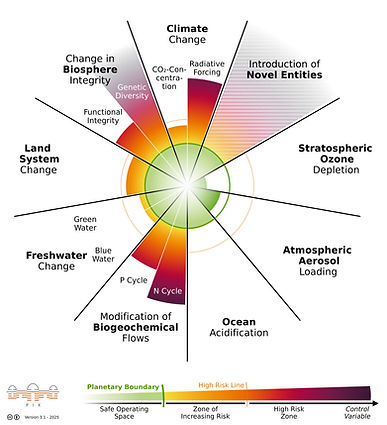
Beyond the Limits: Planetary Boundaries and Where We Stand
A companion piece to "Earth in Balance: The Great Cooperation"
A Framework Born of Urgency
In 2009, a group of Earth system scientists at the Stockholm Resilience Centre asked a deceptively simple question: how much can human activity push the planet's natural systems before those systems stop functioning reliably? The answer took the form of a framework called Planetary Boundaries — nine measurable thresholds in Earth's critical systems that, if crossed, risk pushing the planet out of the stable state it has maintained for the past eleven thousand years.That stable state has a name: the Holocene — the geological epoch that began at the end of the last ice age and encompassed the entire rise of human civilization.
Every city ever built, every crop ever planted, every civilization that has risen and fallen did so within the remarkably steady climate and ecological conditions of the Holocene. Moderate temperatures. Reliable rainfall. Stable coastlines. Predictable seasons. We designed everything we have around those conditions, often without realizing it.
The planetary boundaries define the guardrails of that stability. They are not arbitrary political targets. They are scientific estimates of the limits within which the Earth system — the web of atmosphere, ocean, soil, ice, and life described in Earth in Balance — can absorb human pressure and still maintain its capacity to self-regulate. Cross them, and you risk triggering shifts that are not just damaging but potentially irreversible: changes that could lock the planet into a new state, one far less hospitable to the civilization we have built.
The 2025 Planetary Health Check — the most recent comprehensive assessment — tells us where we stand. The picture is stark.
Seven of Nine: The Scorecard
Of the nine planetary boundaries, seven have now been breached. All seven show worsening trends. Only two — stratospheric ozone depletion and atmospheric aerosol loading — remain within safe limits. This is not a prediction of future danger. It is a description of where we are right now.
Here is what has crossed the line, and what it means.
1. Climate Change
This is the boundary most people know. The safe threshold for atmospheric carbon dioxide is 350 parts per million — the upper limit of the range in which Earth's climate remained stable throughout the Holocene. We currently stand at 423 parts per million, and the level is rising. The high-risk threshold — beyond which large-scale, potentially irreversible shifts become significantly more likely — is 450 ppm. We are closing in on it.
Radiative forcing, the measure of how much extra energy the atmosphere is trapping due to human emissions, now sits at nearly double the high-risk threshold. The consequences are already visible: the past nine years have been the hottest in recorded history. Ice sheets are losing mass. Sea levels are rising at an accelerating rate. Weather patterns that billions of people and agricultural systems depend on are shifting.
Climate change does not operate in isolation. It amplifies every other boundary it touches.
2. Biosphere Integrity — The Unraveling Web
In Earth in Balance, the web of life is described as the source of Earth's resilience: the more connections, the more niches filled, the more robust the whole system. Biosphere integrity is the measure of how intact that web remains.
It is unraveling at a rate that has no precedent in human history.
The safe threshold for species extinction is fewer than 10 extinctions per million species per year — already a generous allowance above the natural background rate. The current rate exceeds 100 extinctions per million species per year, and it is accelerating. An estimated one million species are now threatened with extinction. More than 10% of the genetic diversity of plants and animals has been lost in the past 150 years alone.
Beyond extinctions, humans now appropriate 30% of all energy produced by plants — through agriculture, logging, fishing, and land conversion — leaving far less for the rest of the web of life to run on. The safe boundary is 10%. We are three times over it.
This matters for reasons that go far beyond the loss of individual species. As the Science section of this website explores in detail, every species plays a role. Lose enough of them, and the cascades that hold ecosystems together begin to fail. The web does not simply become thinner — it can collapse.
3. Land System Change
Forests, grasslands, and wetlands are not merely scenery. They are functional organs of the Earth system — regulating water cycles, storing carbon, filtering air and water, stabilizing soils, and providing habitat for the majority of life on Earth. Conversion of these systems to agriculture and urban development is one of the most direct ways humans have reorganized the planet's surface.
Approximately half of Earth's habitable land has been converted from its natural state. Tropical forests — the most biodiverse ecosystems on Earth and the engines of the "flying rivers" that carry moisture across continents — are being lost at rates that undermine regional rainfall patterns and global carbon cycles alike. This boundary has been breached, and the trend continues downward.
4. Freshwater Change
The water cycle, as Earth in Balance describes, is the circulatory system of the planet. The planetary boundary for freshwater is not simply about running out — it is about disrupting the flows that ecosystems and billions of people depend on.
Both the volume of water we withdraw from rivers, lakes, and aquifers, and the way we have altered the timing and routing of water flows through land-use change, now exceed safe limits. Groundwater aquifers that took thousands of years to fill are being drawn down in decades. Wetlands that once moderated floods and droughts have been drained. The boundary is crossed, and in many regions, the consequences — drought, crop failure, water insecurity — are already acute.
5. Biogeochemical Flows: Nitrogen and Phosphorus
Nitrogen and phosphorus are the nutrients that make agriculture possible. They are also, in excess, among the most disruptive forces in the natural world.
Industrial fertilizers have flooded the planet's soils, rivers, and coastal waters with nitrogen and phosphorus at levels the Earth system has never before experienced. The result is a cascade of damage: algal blooms that choke oxygen from lakes and coastal waters, creating vast "dead zones" where almost nothing can live. The Gulf of Mexico dead zone, fed by agricultural runoff from the American heartland, is one of hundreds worldwide. Natural nutrient cycles that took billions of years to evolve are being overwhelmed in decades.
6. Novel Entities: The Chemical Flood
This is perhaps the least-known boundary, but its breach is no less significant. Novel entities are substances and materials that did not exist in the natural world before human industry created them: synthetic chemicals, plastics, heavy metals, radioactive materials, and genetically modified organisms released into the environment.
Over 350,000 synthetic chemicals are now registered for production and use worldwide. Microplastics have been found in the deepest ocean trenches, in Arctic ice, in human blood, in the placentas of unborn children. Many of these substances are persistent — they do not break down, they accumulate, and their interactions with living systems are poorly understood. The pace of introduction far outstrips our ability to assess the risks.
7. Ocean Acidification — The Newest Breach
The most recent addition to the list of crossed boundaries, confirmed in the 2025 Planetary Health Check, is ocean acidification. Since the beginning of the industrial era, the oceans have absorbed enormous quantities of carbon dioxide — a service that has slowed the pace of climate change, but at a steep cost. As CO₂ dissolves in seawater, it forms carbonic acid. The oceans have already increased in acidity by 30 to 40%.
This matters profoundly for marine life. Corals, shellfish, and many species of plankton build their shells and skeletons from calcium carbonate — a compound that literally dissolves in more acidic water. Coral reefs, which support approximately a quarter of all marine species despite covering less than 1% of the ocean floor, are bleaching and dying at unprecedented rates. The foundation of the ocean food web — the microscopic plankton that, as Earth in Balance notes, produce much of Earth's oxygen — is under stress.
The Two That Remain: A Lesson in What's Possible
Ozone depletion and aerosol loading remain within safe limits — and the reason why is worth pausing on.
The ozone layer was in serious danger by the 1980s. The evidence was clear, the scientific consensus was solid, and the world acted. The Montreal Protocol of 1987 phased out the chemicals responsible. Today, the ozone layer is slowly healing. It is one of the clearest examples in history of humanity identifying a planetary boundary threat and pulling back from it in time.
As Johan Rockström, Director of the Potsdam Institute for Climate Impact Research, has said of the current situation: "Failure is not inevitable; failure is a choice." The ozone story proves it. The systems that sustain life on Earth are not infinitely forgiving, but they are remarkably resilient — when given the chance.
The Interconnection Is the Point
What the planetary boundaries framework makes clear — and what cannot be overstated — is that these nine systems are not independent gauges on separate dials. They are woven together, exactly as the great cooperations described in Earth in Balance would predict.
Climate change accelerates biodiversity loss. Biodiversity loss weakens the capacity of ecosystems to absorb carbon. Deforestation disrupts water cycles and accelerates climate change. Ocean acidification reduces the ocean's ability to absorb CO₂, which accelerates climate change further. Each crossed boundary makes the others harder to hold.
The interconnectedness that makes Earth so resilient in balance makes it, when pushed too far, vulnerable to cascades. Tip enough threads in the web, and the web as a whole can shift to a fundamentally different configuration — one that did not exist during the Holocene, and one that our civilization was not built for.
Where This Leaves Us
Seven of nine boundaries crossed. All seven trending in the wrong direction. The window for course correction is real, but it is not permanent.
The planetary boundaries framework is not a counsel of despair. It is a diagnosis — and like any diagnosis, its value lies in what it makes possible: a clear understanding of what needs to change, and why. The Earth system that built the Holocene, that sustained ten thousand years of human flourishing, is still largely intact. It is under enormous pressure, but it has not yet crossed the thresholds beyond which recovery becomes impossible.
That distinction — between damaged and lost, between stressed and broken — is everything.
Understanding the balance, as this website's Science section describes it, is the first step. Understanding what threatens that balance — and how far the threats have already advanced — is the second.
The third step is ours to take.
The planetary boundaries framework was developed by the Stockholm Resilience Centre and the Potsdam Institute for Climate Impact Research. The 2025 Planetary Health Check is the most recent comprehensive assessment of all nine boundaries.
"A bad tipping cascade could result in a loss of control over the climate problem, with damaging changes reinforcing each other."
Dr. Timothy Lenton, National Emergency Briefing, Dec. 2025